
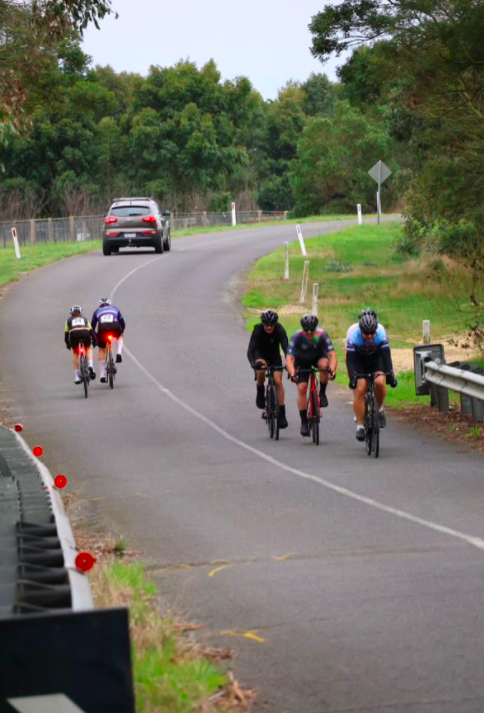
Stage 9 of this year’s men’s Giro d’italia was a medium mountains stage, and by the last climb, 8 riders were left at the front of the race.
With 2.5km to go until the mountain top finish, Felix Gall attacked out of the group. The race’s hot favourite, Jonas Vingegaard, soon after bridged across to him, and they took off together.
Both Felix and Jonas’s strategy at that point was to gain as much time as possible on their opposition, by riding hard to the finish line. But despite being asked by Felix, Jonas didn’t contribute to the workload and pacing, choosing instead to sit in Felix’s draft, at the risk of lessening the time they could both gain by the end of the stage*.
* In cycling, riding in the slipstream of another rider is a significant performance advantage – physically the energy saved can be huge depending on the situation and rider positioning. For example, someone riding solidly on the front of a group could be at close to a maximal effort, while another rider seven wheels back could be cruising easily. It can also be significant tactical and psychological advantage.
And then the questions came.
Broadcast commentators: “Interesting Jonas isn’t working with Felix..”, “He’s not contributing to the pace making..” and “Why do you think he would he be doing this?”
A tactical enquiry.
But it didn’t take long for it to move into culture and identity stamping**.
** In performance-based road cycling at any level, due to this slipstreaming effect, there’s a cultural element that says you shouldn’t shirk work.
Not a bad general principle, is it?
As humans in life, we build strength by moving through resistance and accepting the experience of it, so riding on the front of a group or riding solo with intent, builds riding strength and fitness more than drafting behind riders.
This is crucial to capability in a sport in which the physical domain is so influential compared to say, the technical movement skill contribution. In cycling, if you ain’t got the legs, you ain’t gonna party.
But this cultural element also shows up by saying if you want to be respected, considered a good rider, and really part of the tribe; if you want to be seen and accepted, you should contribute to the speed of the group by taking a turn on the front where you set the pace, break the wind, use more energy, and give others a rest. Well organised groups will rotate through at steady intervals.
Like I said, it’s sound.
So much so, it’s something that many riders identify with – working hard.
But in racing, the end goal isn’t to be strong or demonstrate your capacity.
It’s to cross the line first. And with the drafting aspect, how and when, you use your energy and capacities, is everything.
Working hard? Sure – it’s required, and don’t worry, you will.
But in the service of what?
Back to the Giro.
With 800m to go, having sat on Felix’s wheel for about 5 mins, Jonas attacked, got a gap on him, increased it to the line, took the stage win, and time on his nearest rivals for the overall 21 day race.
And then came the criticisms.
From media and punters alike:
“Why didn’t he work with Felix?” “What a dog!” “Weak bloke” “Never takes a pull, boring racer.” “That’s why X is a better rider”.
The guy had just won the stage, gained time for the overall tour, showed his dominance and sent a message to all involved.
But it wasn’t enough.
Not for the cultural guardians. No way.
And this …………. is the common conflation.
Conflating:
- Training with Racing.
- Work ethic with Results.
- Performance with Belonging.
Riders can get so caught up in the idea of “doing work”, they forget about the purpose of that work.
In those situations, “doing work” often becomes a way of avoiding accountability.
A safer commitment.
An easier measurement.
Avoiding the real work.
They can be so tied up in showing themselves as an accepted member of the tribe, that it comes at the expense of their actual performance.
In performance and leadership, for sport and business identity is often used as a key driver for what we’re moving towards. A lot of time is spent clarifying who we are and who we want to be. It’s used as a proactive lever, that intends to draw us forward.
But it’s critical we also examine our identity for how it might be anchoring us back.
An honest and non-judgemental clarification, and acceptance, of our existing identity is required if we want to grow or leverage it.
It’s also critical in relation to the results we say we want to achieve.
We can be obliviously kidding ourselves, or actually freeing our potential. It’s our choice.
But can we make it?
It’s a big opportunity. But only if we can see it.
Identity must be leveraged as a fundamental, but sometimes the identity we have, is the problem we have.
Hiding in plain sight.
Do you REALLY want performance?
Because if you do, be prepared.
To be faced with a challenge. A learning.
The challenge of giving more of yourself than you ever thought was on the table in the first place.
Not more of your resources, more of your self.
So …….
do you really want the results, or just to feel more secure in the culture, safe in the tribe?
Or…… could there be a third way?